Somewhere between the third satisfying reel of someone steam-mopping a herringbone floor to an acoustic cover of a pop song, and the fourteenth Pinterest board entitled something like “Clean Girl Autumn Living” featuring a spotless kitchen that has clearly never produced an actual meal, I started to feel something. Not inspiration. Not the gentle nudge to go and sort out my own skirting boards. Something closer to the feeling you get when someone describes sitting in traffic as “a chance to decompress.”
Cleaning, it seems, has had a rebrand. It is no longer the domestic task that eats your Saturday morning and smells of bleach. It is, according to a growing and apparently very enthusiastic corner of the internet, a hobby. A passion. A form of self-care. A meditative practice with its own aesthetic, its own product lines, and its own devoted content creators who will show you, in a deeply satisfying forty-five second video, how to fold a cleaning cloth in a way that brings genuine peace to the soul.
I am Cindy. I clean houses across London for a living. I have been doing it long enough to have strong opinions, lightly worn but firmly held. And I have some thoughts about the Cleaning Hobby Industrial Complex that I have been keeping to myself for quite some time. Not any more.
The Reel Versus the Reality
Let us start with the content, because the content is where it all begins. If you have spent any time on Instagram or TikTok in the last few years, you will have encountered the cleaning reel. You know the one. A gleaming kitchen. A hand in a pink rubber glove applying product to a surface that was, if we are being truthful, already fairly clean. The product foams satisfyingly. The cloth moves in hypnotic circles. A timer appears on screen in a cheerful font. The reveal: the surface, now marginally shinier than before, glistens under ring-light lighting while a lo-fi playlist murmurs approvingly in the background.
The comments are rapturous. “This is my therapy.” “I could watch this for hours.” “You’ve inspired me to deep clean my whole flat tonight!” The creator beams, recommends three products in the caption, and watches the affiliate links do their quiet, lucrative work.
I watch these videos too, occasionally, usually while sitting down after a full day of cleaning homes that do not have ring lights or acoustic soundtracks. And every time, without fail, I think the same thing: that is not what it looks like.
What It Actually Looks Like
It looks like getting on your hands and knees behind a radiator in a house in Battersea and removing something you genuinely cannot identify. It looks like hoovering a mattress on both sides, in a room with no air conditioning, in August. It looks like scrubbing a hob that has not been properly cleaned since the coalition government, wearing gloves not for the aesthetic but because the degreaser will take your fingerprints off if you are not careful.
It is physical. It is repetitive. Your back registers its objections by mid-afternoon. You develop strong and specific opinions about mop head designs, about the precise angle at which a grout brush is most effective, about which brand of microfibre cloth is worth the money and which is simply a flannel with ambitions. These are not the opinions of a hobbyist. They are the opinions of a professional who has earned them, one bathroom at a time.
The Particular Offence of the Cleaning Aesthetic
Here is where I want to be generous, because I am a generous person and also because I have teenage children who have shown me that aesthetics matter more than I fully appreciate. I understand that the cleaning content world is not entirely cynical. Some of those creators genuinely find satisfaction in order and want to share it. Some of the products are actually good. And if watching someone clean their bathroom at sixty frames per second inspires you to clean yours, then something useful has happened in the world.
What I take issue with – gently, but clearly – is the aesthetic that has built up around it. The notion that cleaning becomes pleasurable and aspirational once it is performed with the right products, in the right outfit, to the right music, in a home that already looks like a boutique hotel at the start of the video.
The Outfit Problem
The cleaning outfit. We need to talk about the cleaning outfit.
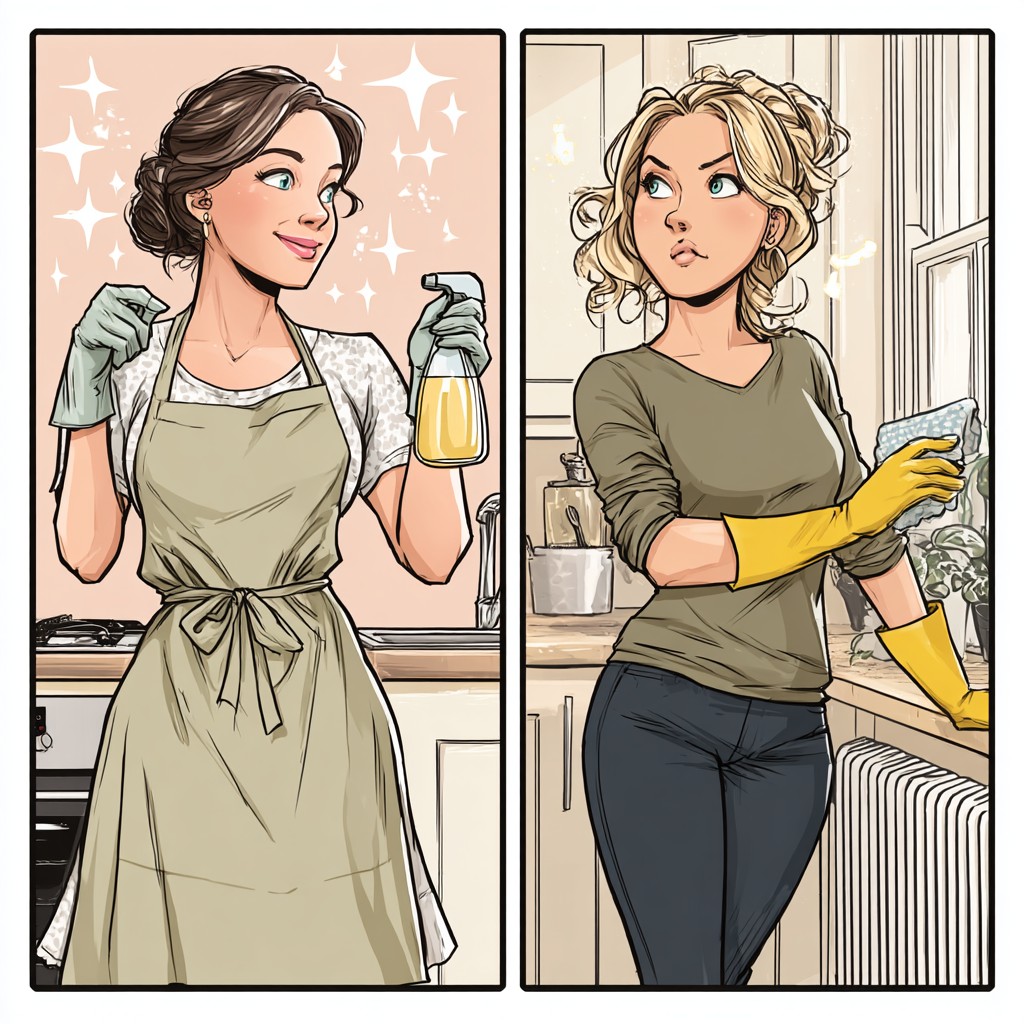
I clean in clothes I do not mind ruining. Dark leggings, an old top, hair entirely out of the way by any means necessary – a combination that has been described by my daughter, memorably, as “aggressively practical.” I have never once, in all my years of professional cleaning, felt the urge to do it in a co-ordinated neutral-toned loungewear set with my hair in a perfect bun and a personalised apron tied just so.
The cleaning content creators, however, look as though they are about to host a very calm lifestyle podcast, and have decided to wipe a surface first. The aprons are linen. The gloves come in sage green and terracotta. There is, in some corners of the internet, an entire subculture of people who collect aesthetically pleasing spray bottles and decant their products into matching amber glass vessels labelled in a tasteful font.
I once turned up to a client’s home in Notting Hill and she had done exactly this. Every product – and she had a lot of products – decanted into matching bottles with handwritten labels, arranged on a small tray like a very committed still life. I appreciated the effort. I also spent the first ten minutes working out what was actually in each bottle because the labels said things like “citrus blend” and “fresh home” rather than, you know, what they were.
The Wellness Angle, or: No, This Is Not Mindfulness
The part of the Cleaning Hobby discourse that really gives me pause is its intersection with the wellness industry. Cleaning as a form of mindfulness. Cleaning as a way of reclaiming agency over your environment and therefore your mental state. Cleaning – and I have read this more than once, in earnest publications that should know better – as a form of meditation.
I want to be careful here, because there is something genuinely true in the idea that order and cleanliness can reduce anxiety, and that the act of cleaning your home can make you feel better about your surroundings. That is real. I have seen it, in clients who visibly relax when I hand the kitchen back to them. I believe it.
But there is a considerable distance between “a clean home makes me feel calmer” and “cleaning is my mindfulness practice.” One is an observable fact about human beings and their environments. The other is what happens when the wellness industry finds a domestic task and gives it a rebrand, a journalling prompt, and a podcast episode.
What Mindfulness Actually Looks Like With a Mop
When I am cleaning professionally, I am not meditating. I am thinking about whether I remembered to bring the correct brush for the grout on this particular floor, whether the anti-limescale product needs more contact time on these taps, and whether I can finish the bathroom in time to eat something before my next job. I am also, fairly often, composing strongly-worded internal monologues about people who put stickers on glass and do not remove them fully.
This is not a criticism of mindfulness. It is a defence of honest work. What I do requires skill, physical effort, and experience. Dressing it up as a spiritual practice does not elevate it – it obscures it. And it obscures, in particular, the labour of the people who do it every day not as a form of self-expression but as a job.
What I Actually Think Cleaning Is
Cleaning is maintenance. It is the ongoing, unglamorous, entirely necessary work of keeping a living space functional, healthy, and habitable. It sits alongside cooking and laundry and fixing things when they break – the quiet infrastructure of a life, running in the background so that everything else can happen in the foreground. When it is done well, no one notices. When it is neglected, everyone does.
It can be satisfying. Deeply satisfying, actually – the before and after of a room brought back to order is a real and legitimate pleasure, and I will not pretend otherwise. There is something that happens when you finish a room and look back at it that is its own small reward, and I have felt it in hundreds of homes across this city.
The Line Between Satisfaction and Hobby
But satisfaction is not the same as hobby. I find parallel parking satisfying when I get it exactly right first time. I do not have a parallel parking aesthetic, a favourite parallel parking product, or a TikTok account dedicated to my most rewarding parking moments.
Cleaning is work. For some of us, it is professional work – skilled, physical, and deserving of the same straightforward respect we extend to other skilled trades. For everyone else, it is a domestic responsibility – not a chore to be dreaded or a pleasure to be performed, but simply a reasonable part of running a home that benefits from being done regularly and done properly.
You do not need a matching spray bottle set for that. You do not need a linen apron or a curated playlist or a twelve-step routine that takes longer to film than to complete. You need the right products, a reasonable technique, and enough motivation to get it done before the weekend disappears entirely.
And if you genuinely love it – if the cleaning reel truly is your therapy and the amber decanting truly does bring you peace – then I am glad for you, sincerely. Live your best organised life. I will be here in my aggressively practical leggings, cleaning the same homes I cleaned last week, earning my living one bathroom at a time.
The brass tap in Chelsea is not going to polish itself.